Results Viewer


|
Results Viewer |
|
|
Standalone DesignBuilder Results Viewer The Results Viewer is a separate application which can be used to view EnergyPlus results stored in one or more .eso files. It can be downloaded from the main Downloads > Software area of the DesignBuilder website. When installed the application allows you to view any results contained within EnergyPlus .eso and .htm results files. There are 3 ways to open .eso results files:
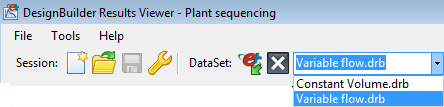
Multiple .eso and .htm files can be opened at a time. Use the combo box below the toolbar to select the current results set for plotting.
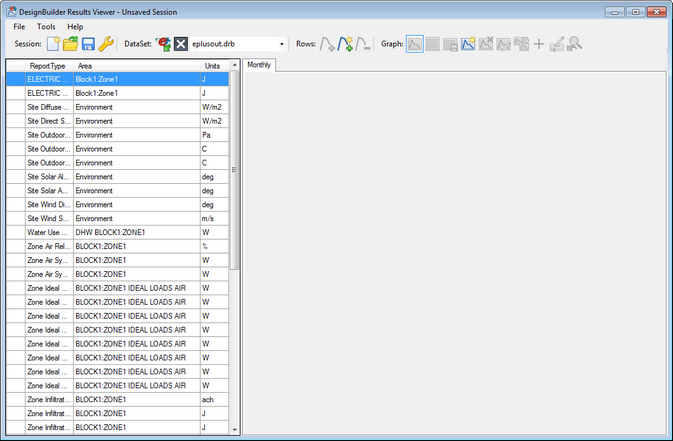
With an .eso file open the first view will be something like that shown below.
DISPLAY RESULTS To show results for a particular interval use the Frequency drop list to select the interval.
Sorting the Reports can be a useful way to help find particular data and can be achieved by clicking on the column headers. For example to see data sorted by "Area" click on the Area header. This will collect together all data for each zone, HVAC component, Environment etc. in the list.
To plot a report on a graph use one of these methods:
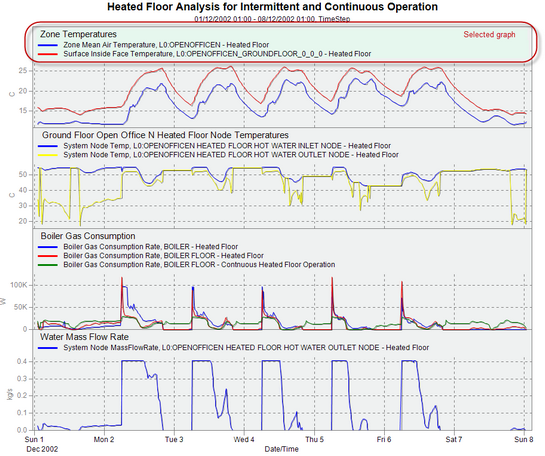
Selecting a graph If you have more than 1 graph set up you can select the current graph simply by clicking on it. You will see the graph heating highlight in a different blue when selected as shown below.
MENU COMMANDS You can access a range of options from the top bar menu, toolbar and right-click context menus. These are as follows: Display grid Display the data as a grid instead of a graph. Display graph Display the data as a graph instead of a grid. Save grid to CSV Allows you to save the data as a comma separated values file for loading into a spreadsheet for further analysis. Copy graphs to another frequency If you have generated similar data for multiple frequencies then use this tool to use settings for the current frequency and display the same reports using a different frequency. Change main title Change the text to be used for the main title for all graphs Rename graph title Allows you to change the title for the currently selected graph. To change the name of the current graph right-click on the graph and from the DesignBuilder Options, select the Rename graph title option. Enter the title for the graph in the dialog and press OK. Remove selected graph Deletes the current graph. Any data displayed in the graph is unaffected. Cross hair on/off Checking this option displayed a cross hair which allows you to create a vertical and horizontal line when you click on a data point. It can be useful to check simultaneous values for a range of reports. Template Load/Save When you create graphs with Results Viewer, they are styled (e.g. Title Font, Background colour, etc) using a default styling template. You can change the styling defaults to your own preferences by using the right-hand context menu on the graph pane. The following options are currently available:
If you make some changes and want to revert back to the default styling at any time, select the Tools > Restore Graph Styling menu option.
Any styling changes made to the currently open session will be made permanent once the session has been saved.
If you wish to reuse your styling changes, you can save these to a styling template file and apply them to other sessions. Use the Tools> Template > Save option to save your styling template as a standalone file, ie outside of the session (note: the '.drt' file extension is used for styling template files). The Tools > Template > Load option can then be used to apply this style to another session. LOADING MULTIPLE DATA SETS You can load as many data sets as required to a single Results Viewer session by using the Open eso/Dataset menu or toolbar option. A list is maintained of all data sets currently opened in the drop list at the top of the window.
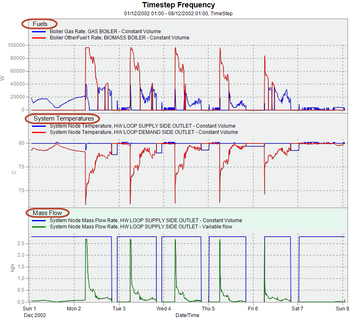
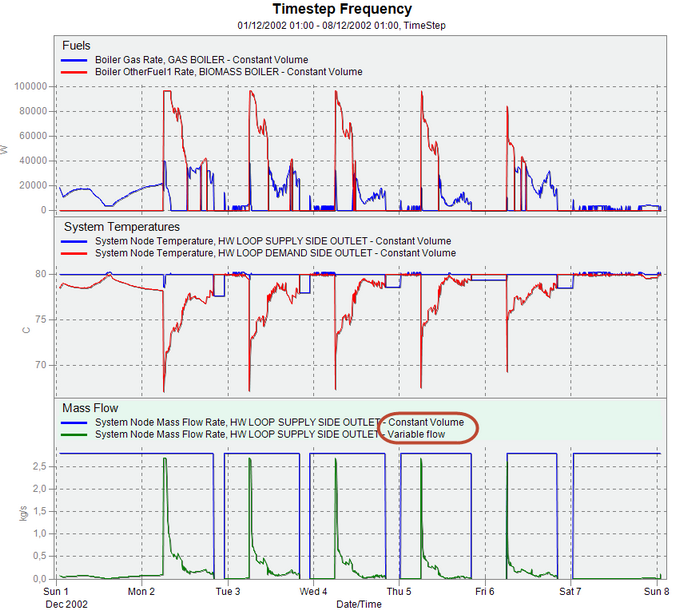
When you have more than one data set open it usually helps to Include the dataset name in the legend. This can be done from the Options dialog. OPTIONS DIALOG The Options dialog is accessed either from the toolbar Autosave session Select this option if you would like the session to be saved automatically when closing the Results Viewer. Display a title for each graph Selecting this option causes the title of each graph to be displayed for each graph as shown in highlighted areas in the graph below.
To change the name of the current graph right-click on the graph and from the DesignBuilder Options, select the Rename graph title option. Enter the title for the graph in the dialog and press OK. Include dataset name in legend If you have more than one data set loaded then you should usually select this option to ensure that the data set name is included in the legend. This can help when comparing results for different simulations.
The output above shows how the dataset name is added to each legend. Include folder name in dataset name If you include the dataset name in the legend then do you want the folder name included too? If so check this option. This option is only usually used when the result sets are stored in files with the same name but in different folders. ZOOMING In some cases you may find that too much data is displayed on the X-axis at one time and you need to focus on a section (time period) of the results graph. You can use the mouse to do this simply by dragging a time region of interest. This allows you to zoom in on data for particular days.
To return back to the original "un-zoomed" state, use the Undo zoom toolbar option. SESSIONS It can take some time to load.eso files and to select results so DesignBuilder provides methods to save pre-processed results files and session files to speed loading and setting up reports the next time. .drb results files When the Results Viewer loads an .eso file it automatically generates a .drb file with exactly the same data but in a form that can be loaded much more quickly. If you need to view the results again in future you can open the drb file instead of the .eso file. The .drb file will have the same filename as the original .eso file (apart from the extension). It does not contain any display settings - just the data. .drs results files You can also save a session file which stores all of your display settings for a graphing session as well as the corresponding .drb file(s). Opening the session file will take you back to where you were before saving the session file. Session files provide a very useful way to package up all data and settings for a Results Viewer session in a small file size. They can be sent to colleagues for viewing. You can configure DesignBuilder to save.eso files in various ways as described for the EnergyPlus tab of the Program options. If you plan to use the Results Viewer in favour of the inbuilt DesignBuilder results display then you might use one of the settings configurations below:
Antardwand Full Movies 720p [extra Quality] Download Link -These films collectively illustrate a growing trend in Indian independent cinema toward , where filmmakers use narrative cinema to spotlight systemic injustices. 8. Legacy and Future Directions Antardwand paved the way for subsequent films and documentaries that tackle forced marriage. The rise of streaming platforms has facilitated broader distribution of such socially conscious content, reaching audiences beyond urban multiplexes. Moreover, the film has been incorporated into curricula for sociology and gender studies in several Indian universities, serving as a case study for the intersection of law, culture, and economics. The story follows an ordinary young man, , and his family as they become victims of this illegal practice. Through a blend of stark realism and empathetic storytelling, Antardwand exposes the cultural, economic, and gendered dimensions of forced marriages, prompting both national debate and international recognition. 2. Historical and Cultural Context 2.1 The Phenomenon of Groom Kidnapping In many rural communities of the Indian heartland, marriage is not merely a union between two individuals; it is a socio‑economic contract that binds families, consolidates property, and upholds social status. While dowry has long been a burden placed on brides’ families, some communities have reacted by kidnapping grooms to avoid paying excessive dowry. The practice involves abducting a young man and compelling him to marry a woman from the kidnapper’s family, often under threat of violence. 2.2 Legal Landscape The Indian Penal Code criminalizes kidnapping (Section 363) and forced marriage (Section 494), yet enforcement remains weak due to social acceptance, local power structures, and lack of awareness. The practice persists in remote villages where police presence is limited and community elders wield considerable influence. 2.3 Cinematic Tradition Indian cinema has historically tackled social evils—think of Mother India (1957) or Aparajito (1956). However, few mainstream films have directly addressed groom kidnapping. Antardwand is significant as it brings an under‑reported issue to a broader audience, employing a naturalistic style reminiscent of Italian neorealism and the “new wave” of Indian independent cinema. 3. Plot Synopsis Mohan (played by Raj Singh Chaudhary) is a 23‑year‑old mechanic living with his parents and younger sister in a small Bihar village. He dreams of a better future, possibly moving to the city for work. One day, a group of men, led by a local strongman, forcefully abducts him and brings him to a neighboring village. There, he is thrust into a marriage ceremony with Sonal , a 19‑year‑old girl who herself is a victim of the same system. antardwand full movies 720p download link 1. Introduction Antardwand (English: “Forced Marriage”) is a Hindi‑language drama directed by Sushil Rajpal and produced by Shubhashish Bhutiani and Amitabh Sharma. The film premiered at the 2010 Cannes Film Festival’s “Un Certain Regard” section, where it received a special mention for its courageous handling of a socially sensitive issue: groom kidnapping (known locally as pakadua vivaah or pakadua ) in certain parts of northern India, particularly in the states of Bihar, Uttar Pradesh, and Jharkhand. These films collectively illustrate a growing trend in While the film may not have eradicated the practice, it undeniably contributed to the , prompting legal reforms, heightened media attention, and a growing awareness among the public. As India continues to grapple with entrenched social customs, works like Antardwand remind us of the transformative potential of cinema: to illuminate hidden injustices, challenge the status quo, and ultimately, inspire change. If you are interested in watching Antardwand legally, it is available on several reputable streaming platforms and may be found in select regional DVD collections. Supporting official releases helps ensure that filmmakers can continue to create socially important works. The rise of streaming platforms has facilitated broader The film follows the psychological trauma, the family’s desperate attempts to locate Mohan, and the legal battles that ensue. As the story unfolds, both Mohan and Sonal are forced to confront the loss of agency, the weight of societal expectations, and the limited avenues for redress. The narrative ends ambiguously, reflecting the ongoing struggle of countless real‑life victims. 4.1 Patriarchy and Gendered Violence While the headline act—groom kidnapping—targets men, the film reveals a dual oppression : the kidnapped groom is coerced into marrying a woman who is herself a commodity in a system that values women primarily for their marital prospects. Sonal’s lack of consent underscores that the practice reinforces patriarchal control over both genders. 4.2 Economic Exploitation Antardwand highlights how poverty fuels the practice. Families unable to pay dowry view kidnapping as a financial shortcut , while families of the kidnapped groom often suffer economic loss (lost wages, medical expenses). The film illustrates the vicious cycle where economic marginalization leads to illegal practices that further entrench poverty. 4.3 The Role of the State Through the depiction of a reluctant police officer and a half‑hearted legal proceeding, the film critiques institutional apathy. The legal system is portrayed as a bureaucratic maze that fails victims, reflecting real‑world gaps between legislation and enforcement. 4.4 Identity and Agency Mohan’s transformation—from a hopeful, independent youth to a resigned participant in a forced marriage—mirrors the loss of individual identity under communal pressure. The film’s close‑up shots of his eyes, often filled with emptiness, convey the internal erosion of agency. 4.5 Moral Ambiguity Rather than offering a simplistic “good‑vs‑evil” narrative, Antardwand presents characters with nuanced motivations . The kidnappers rationalize their actions as protecting family honor; the victims’ families are torn between societal expectations and personal anguish. This moral grayness forces the audience to confront uncomfortable truths about communal complicity. 5. Cinematic Techniques 5.1 Realist Aesthetic The director employs hand‑held cameras , natural lighting, and non‑professional actors for minor roles, creating an immersive, documentary‑like feel. The rural setting is captured with long, lingering shots that emphasize the starkness of the landscape and the isolation of the characters. 5.2 Sound Design Ambient sounds—cicadas, distant cattle, murmuring crowds—are foregrounded, while a sparse, minimalistic score by composer Rohit Kulkarni appears only during moments of heightened emotional tension, amplifying the sense of realism. 5-1. Editing and Pacing The editing is deliberately unhurried , allowing scenes to breathe. This pacing mirrors the slow, bureaucratic progress of legal recourse, reinforcing the film’s thematic concerns. 5-2. Symbolic Imagery Key visual motifs—such as a broken chain (representing broken freedoms) and rain (signifying both cleansing and melancholy)—are woven throughout, adding layers of symbolic meaning without sacrificing the story’s grounded nature. 6. Reception and Impact 6.1 Critical Acclaim Antardwand received critical praise for its bold subject matter and unflinching realism. Critics highlighted its “courageous storytelling” (The Hindu) and “masterful restraint” (Variety). At Cannes, the film’s special mention signaled its international relevance. 6.2 Social Influence Following its release, NGOs working on child marriage and forced marriage cited the film in awareness campaigns. A notable increase in media coverage of groom kidnapping in Bihar occurred in 2011, leading to a modest uptick in police interventions. 6.3 Controversies The film faced pushback from certain community leaders who accused it of “defaming rural culture.” Some political groups attempted to block screenings, but the Supreme Court upheld the film’s right to free expression, reinforcing the principle that art can address social ills. 7. Comparative Works | Film | Year | Issue Addressed | Similarities | |------|------|-----------------|--------------| | Matrubhoomi | 2003 | Female infanticide | Rural setting, social critique | | Peepli Live | 2010 | Farmer suicides | Satirical tone, uses realism | | Court | 2014 | Judicial corruption | Focus on institutional failure | | Article 15 | 2019 | Caste discrimination | Depicts systemic oppression |
|
 or from the Tools top menu option.